Barebone Framework
Starting point
Barebone Framework Docs
Barebone Studio
Action
Access Control List (ACL)
Activerecord
Barebone URL's
Blokx
Browser Console
Build php classes with php classes
Condition
Config
Controller
Controller / Application Model
Console
Database
FastAPI
Filter $_POST
HTML
Inspector
JSON
JQGrid builder
Layouts
Log
Loggers
Map
Math
Model
Paginator
Pair
Process
Readers
Request
Response
ReRoute
Save as project
URL Helper
Views
ViewGroup
Writers
Zen coding
Barebone\Blokx
Blokx are: Reusable Components Within Applications
In some frameworks, like Barebone, Blokx (or Blokx with an
"x") refer to a specific type of component used for building reusable pieces of HTML. Here's an explanation with additional context,
incorporating your insights:
Blokx: Building Blocks for Your Application:
-
What are Blokx?
- Blokx are similar to views, but their primary purpose is to provide reusable UI components.
- These components represent smaller, well-defined elements like navigation bars, breadcrumbs, sidebars, or other frequently used sections.
-
Where are Blokx stored?
- Blokx are typically stored within the application's dedicated blokx folder (or similar directory name, depending on the framework).
- This central location ensures easy access and management for all the application views that need to utilize these reusable components.
-
Accessibility:
- Blokx are only available within the application where they reside.
- This means they cannot be directly accessed or used by other applications within the same framework. This helps maintain separation of concerns and prevents unintended usage conflicts.
Benefits of Using Blokx:
- Code Reusability: Blokx promote code reuse by encapsulating common UI elements, reducing redundancy and improving maintainability.
- Faster Development: Pre-built Blokx accelerate development by allowing you to integrate them into your views, saving time writing repetitive HTML code.
- Increased Efficiency: Effective Blokx usage leads to a cleaner codebase, improves maintainability, and potentially reduces overall file size and complexity.
Example:
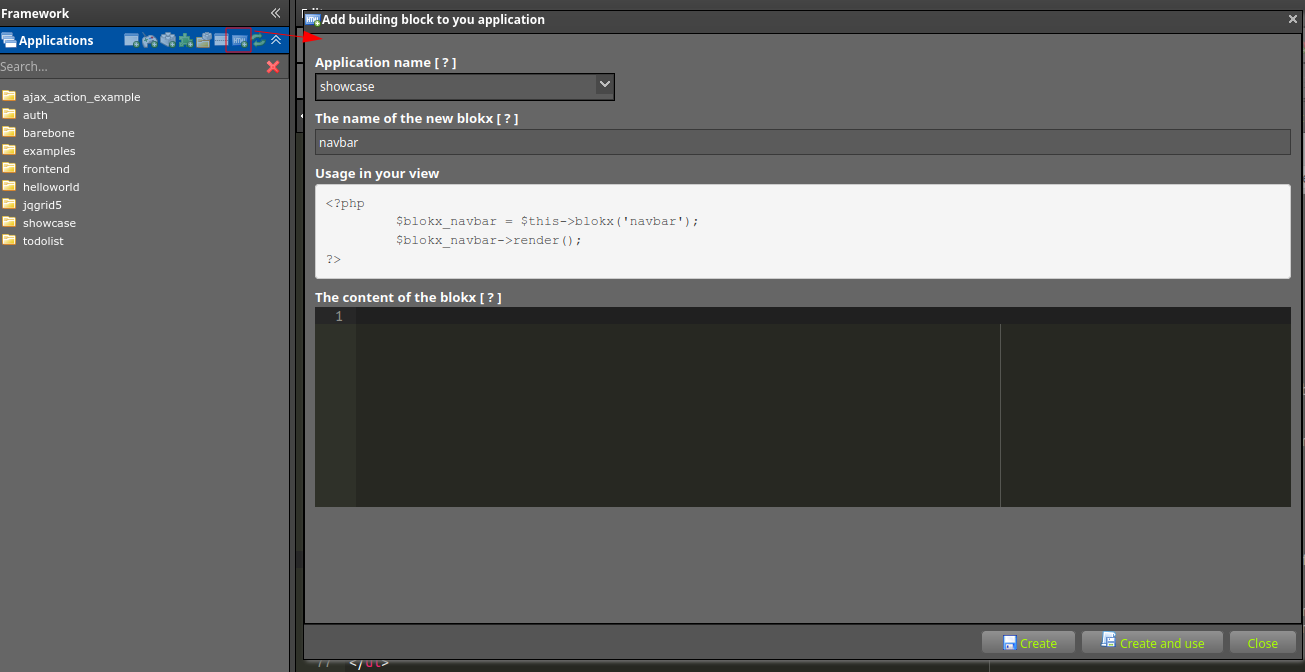
- Create a Blokx named "navbar.phtml" in the application's blokx folder containing the HTML structure for your navigation bar.
- Within your application's views, utilize the code below to include and render the Blokx:
<?php
    $blokx_navbar = $this->blokx('navbar');
    $blokx_navbar->some_var = 'TEST'; // It is also possible to assign veriables to the blokx Element.
    $blokx_navbar->render();
?>
Example using the GUI:
Blokx vs. Framework-Specific Terms:
- While the term "Blokx" is specific for Barebone, the concept of reusable components is prevalent in many web development frameworks and libraries.
- These components are often referred to by different terms like partials, components, or widgets, but they all share the same core functionality of providing reusable building blocks for your application's user interface.
By understanding the advantages and implementation details of Blokx, you can leverage their power to create well-structured and maintainable web applications while streamlining development and improving code efficiency.
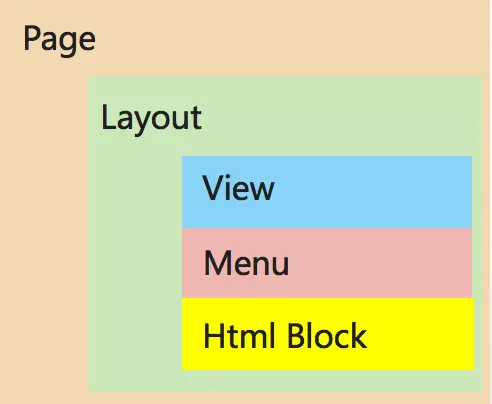
Barebone is all about seperating content and reusing code.
-
Barebone\Blokx
Barebone\Blokx extends Barebone\Component-
[P] $filename : string
-
[P] $nonce : string
-
[M] __construct( string $blokxname, array $data ) : void
-
[M] blokx( string $blokxname, array $data ) : Barebone\Blokx
-
[M] get_html() : string
-
[M] render() : void
-
[M] requestAction( string $route, array $options ) : void
-
Barebone\Component
Barebone\Component-
[P] $properties : array
-
[M] __construct( mixed $data ) : void
-
[M] setData( mixed $data ) : void
-
[M] toArray() : array
-
[M] debug( mixed $data, bool $vardump, $cls_pre ) : void
-
[M] __set( string $name, mixed $value ) : void
-
[M] __get( string $name ) : void
-
[M] __isset( string $name ) : void
-
[M] sanitize_array( array $data ) : void
-
-